Addressing the Elephant in the Room

I lost track of how many times I've heard someone say, children are too young to talk about race. This sentiment is usually coupled with “I don’t see color,” and they both make me cringe. Even though I believe the person sharing these myths and problematic approaches is coming from a good place, we must remember that the road to hell is paved with good intentions. And we must raise the expectations of early childhood educators when it comes to addressing the elephant in the room.
Identity, specifically race, culture, and ethnicity, is the elephant in the room. It’s a humongous aspect of our daily lives, yet people strive to evade seeing what’s right in front of them. People who feel their race, culture, and ethnicity are not important characteristics of their identity often want to treat others the same and downplay something that is a vital part of who they are. And yes, race is a social construction (created by the dominant group to control the subordinate groups), but living as a racialized person in a world built on white supremacy and racial discrimination is a very real experience for the global majority.
And young children are being socialized around race, culture, and ethnicity, whether we think they are ready for it or not. The cycle of socialization does not wait until a person is 12 to begin working. Thus, we can no longer hold on to the misconception that children are too young for this vital work. Instead, we must recognize how racial identity development can be healthy and unhealthy and accept our role in ensuring all children develop healthy racial identity development.
The research is clear. Babies as young as 3 months old can discriminate faces based on skin color. The research found this to hold up even when they used colored ovals instead of pictures of human faces. And they found a difference between babies who were being raised in mono-racial environments and those who had experience with cross-race relationships, in the first 3 months of life! Some believe this birth-race processing system leads to children’s ability to discriminate based on race as they get older. Even though a baby doesn’t know what race they are or what race is, they can distinguish between the skin colors of people who look like them and people who don’t.
As children get older, they begin to label and group things based on various attributes, including racial characteristics. By age three, children display a preference for white playmates. By age 4, Black children predominantly raised in Black communities lose this pro-white bias, but white children continue exhibiting a bias for white playmates. And by age 5, they can assign stereotypes and biases to people based on race, culture, and ethnicity. The research finds a drop in this behavior by age 6, leading some to believe it’s not important that it doesn’t continue. But the researchers suspect the behavior is still happening, but by age 6, they have learned to keep this thinking to themselves. Racial socialization teaches young children not to openly talk about race, culture, and ethnicity, despite having thoughts that need to be discussed, challenged, and supported.
Children are learning about differences from the moment they are born. And our silence allows those stereotypes to fester. While we are feeling good about ourselves for not bringing race into the lives of young children, they are making faulty conclusions and internalizing stereotypes that we refuse to acknowledge and address. Children need the adults in their lives to point out biases, challenge misconceptions, and give them appropriate language to talk about identity.
This is why I created the Framework for Fostering Healthy Identity in the Young Children: Affirming Race, Culture, and Ethnicity in the Early Years. Published by Defending the Early Years, this free resource was designed to help you recognize and accept your responsibility as an early childhood educator to foster healthy identity development and to embrace the opportunity to support young children in becoming confident, capable children with a positive self-image and a positive view of others.
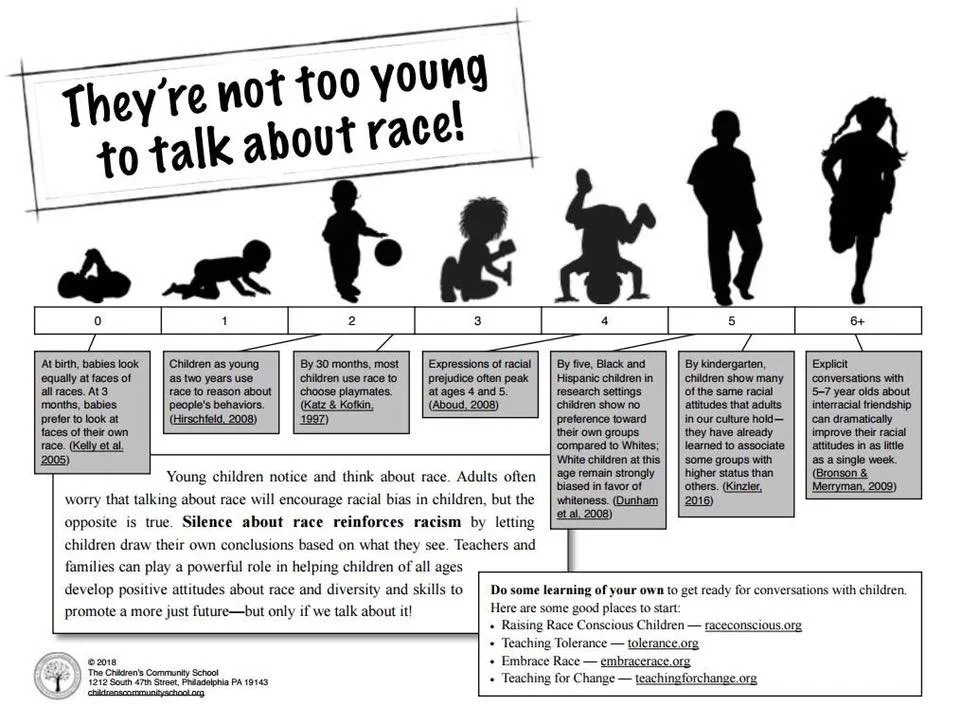
As the image above states, children are not too young to have these discussions. The question is, are you ready to take on your responsibility to support children’s racial learning?
If the answer is yes, but you need help, then you’ve come to the right person. Download the framework and review it carefully. If you want more structured support, join my Mini-Reflective Course on Fostering Healthy Identity in the Early Years. Available to subscribers in my community, Free to Teach = Liberated to Learn, this course includes a recorded video lesson introducing you to the framework, a reflective workbook, and a live, guided, reflective discussion. You get all of this for $10 per course! Join today, and I will let you preview the course for free for 7 days!
And if you want to go even deeper, I’m offering a Reflective Practice Immersion beginning in September. This is a 3-month experience designed for early childhood educators and caregivers who want deeper engagement with theory, practice, and reflection, supported by live facilitation and a learning community. Fostering Healthy Identity in the Early Years: Accepting the Responsibility & Embracing the Opportunity is one of three options for my Fall 2026 Immersion. I will let you all decide which one I offer first. Sign up here and let me know which one you’re interested in.
Also, check out this short video I made on Identity and Belonging in ECEC. Each week, I will explore one of the three guided reflective prompts in more detail!
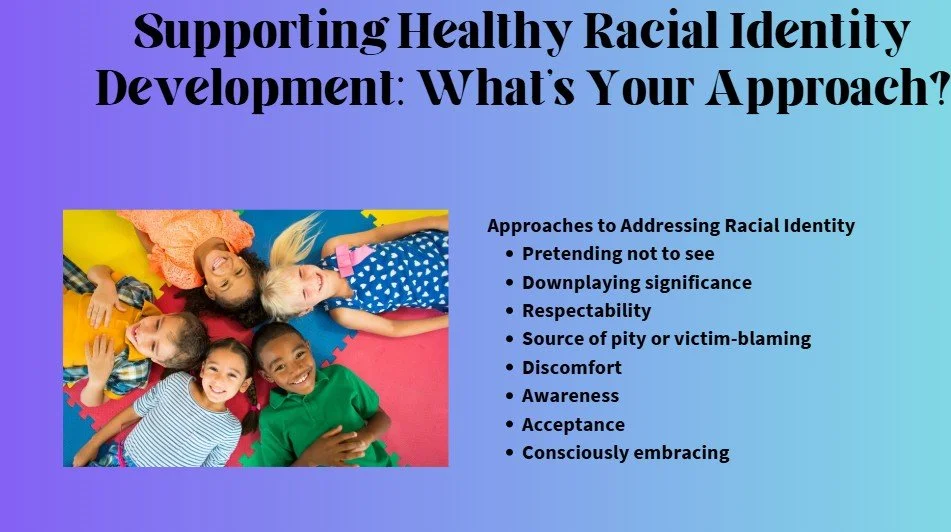
I identified 8 approaches to addressing racial identity. Of those 8, only three are healthy. What is your approach? If it’s one of the top 5 I implore you to reach out and learn a better way. There is nothing wrong with admitting that what you have been doing is not working. The only problem is when you know what you’re doing isn’t working, but you refuse to change it. I hope to work with you on your journey to accept this responsibility and embrace this opportunity! You and the children you care for are worth the investment!