Why Don’t We Trust Children?
While I was studying the role of the teacher in play-led classrooms, I realized that teachers who centered play as a vehicle for learning had a deeper level of trust for young children than teachers who saw play as a break for learning or a class reward. And I saw this trust grow and develop as teachers spent more time leading with play. At the beginning of the year-long playlab project, the teachers I was working with did not initially trust the children, but over time, I saw their trust strengthen, and by the end of the year, they fully trusted the children and their play. Through these observations and discussions, I saw how leading with play required a certain level of trust that isn’t always present in early childhood environments. And I began to wonder, why don’t we trust children?
In early childhood education, most of us are oriented to see children as helpless, fragile, and unsafe. This deficit view of the child means that we are not conditioned to trust them. Instead, we believe they have to earn our trust by demonstrating they can do what we want, in the way we want it done, and when we want it done. That’s a tall order for someone we don’t believe is capable. And I get it, children need our help and guidance, especially when it comes to trying new things. Yes, they are small, and their brains are not fully developed, so they can’t always foresee the risk in what they are doing. But the more I watched young children engaged in hours of true play with minimal interruption and guidance from adults, the more I realized that they were capable of assessing the risk and making their play less risky.
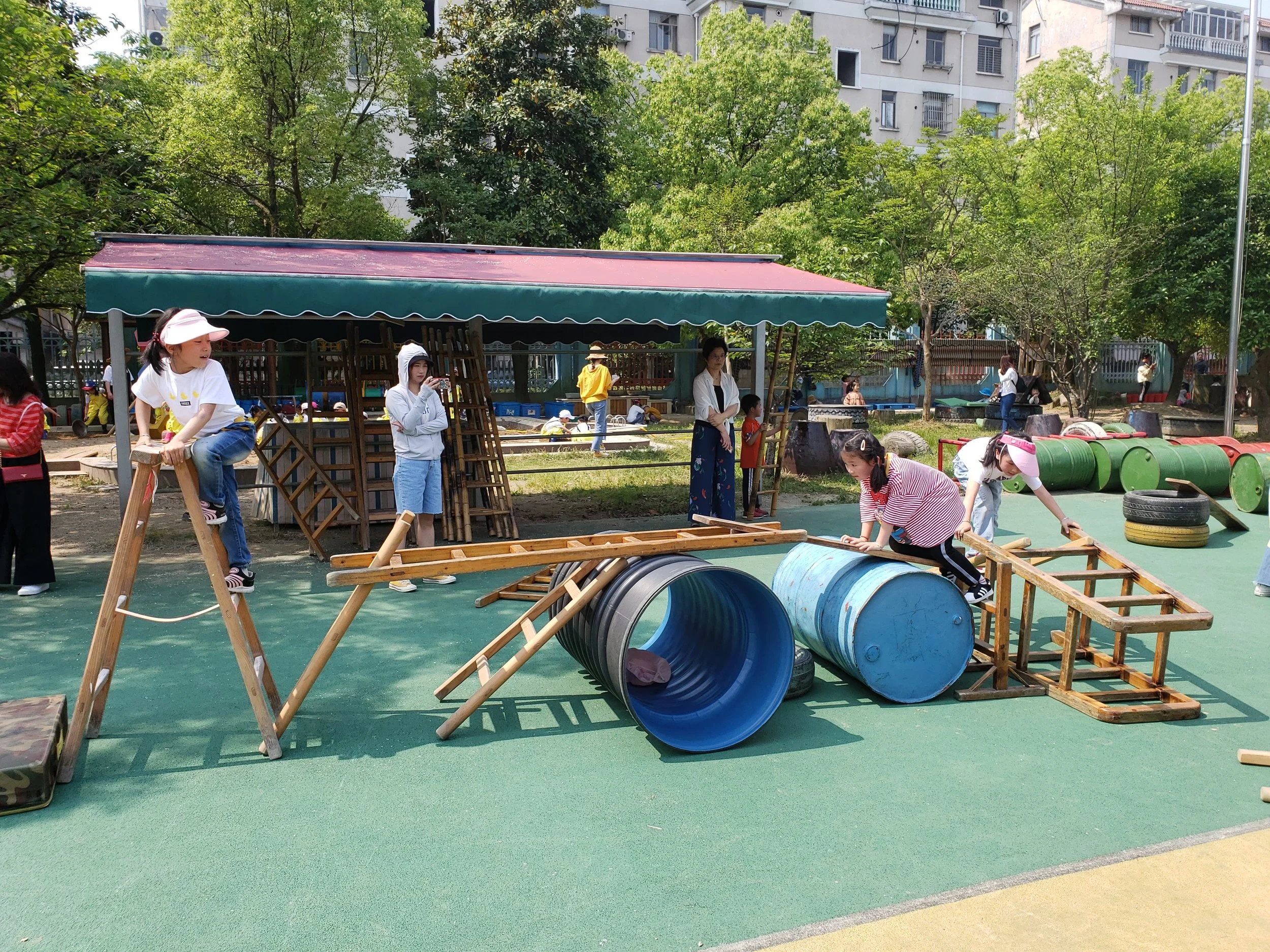
I love this image of these girls from my observation at an Anji Kindergarten in 2019. As I observed this brief scene from their play, I saw how young children were capable of assessing the risk. The girl in the middle approached the structure, but was hesitant to climb across. It appeared unsteady, and she seemed uncomfortable crossing. I didn’t have an interpreter and couldn't fully understand what they were saying in Mandarin, but I got the sense that the girl in front with the hat was telling her it was fine and to just climb across. After a few more back-and-forths, the third girl came over and held the ladder, and then the girl in the middle began to cross it. What I found fascinating was that at no point did a child ask for an adult’s help and no adult intervened. The girls decided for themselves what was possible and what needed some support. She assessed the risk, found it too great, and got help from another child before proceeding. This was a powerful lesson in learning to trust children. You can read more about this and other observations in this article.
I knew that risk was one of the five principles of the Anji play approach to true play, but this observation solidified my understanding of how important trust is in early childhood education and care. Children need to know that we trust them so they can learn to trust themselves. We spend a lot of time in early childhood education talking about helping young children develop trust in their caregivers, but we rarely talk about the need for those same caregivers and educators to trust children. What happens when we trust that children want to be good? Or trust children want to learn? Or trust children want to behave? How does this change our interactions with children? How does beginning with trust reframe how we see challenging behavior? How does an assumption of trust in children's goodness influence our response to what might sound like sass or defiance? If we start with trust and the belief that children are not intentionally spiteful, mean, or willfully defiant, we change our entire approach to their behavior and words.
And we don’t need to just trust children. We need to trust child development. Trust children’s bodies to tell them what they need. Trust children’s developing brains to dictate what they need. Trust children’s voices when they tell us what they need. We also need to trust families. Trust that families love their children. Trust that families want their children to learn and grow. Trust that families are doing the best for their child(ren). And I know someone is thinking, but what about this family who did this or that family who did that bad thing? Yes, those people exist, but they are not the norm. If we begin with fear and mistrust of our families, our children, and their natural development, we do them and our profession a disservice. Begin with trust. See what happens when trust is your foundation.
And there’s one more person we need to learn to trust. You. Trust yourself. Trust that you know what children need. Trust that you are capable of supporting children’s development and learning. Trust that you are doing your best and you will continue to improve. If you don’t trust yourself, you can’t trust the child, trust their development, or trust their family. We must rebuild the circle of trust in early childhood education. This is how we repair the harm done to early childhood education and care by harmful policies, a lack of societal investment, and pressure to make children grow up too soon and learn too fast. Systems of oppression work to erode trust. It’s easier to oppress people who don’t trust their neighbors and don’t trust themselves. If we want to build a better world, we must strengthen early childhood education and care, and the first step is to begin with trust.
Want to learn more? Join my community, Free to Teach = Liberated to Learn, as we discuss trusting young children in our monthly guided reflective prompts. You can also subscribe to my Mini-Reflective Courses (MRC). I launched a new three-part series, Repairing Early Childhood Education and Care, and Begin with Trust is the July MRC. Each MRC is $10, but I’m running a special offer: buy 2, get one free. Join my community today!