Liberated Learning: How Trust, Agency, and Play Can Unleash Children’s Natural Drive for Learning
We know that curiosity is an innate, intense drive that motivates young children to learn through active exploration and relationships. Whether it’s the sensory exploration of a two-year-old or the endless questions of a four-year old, young children are built to learn new information. Fueled by intrinsic motivation, young children desire to learn and know about the world. So if children are naturally curious, have an innate desire to know things, why is learning in school often experienced as a mind-numbing chore? Now I know not all kids feel this way about learning or school. I, for one, loved going to school, and I loved learning so much that I became a teacher and then a teacher educator. I would go back to school right now if I weren’t so close to having all my student loans forgiven! But many children today do not like going to school, and when you ask them why, they often say that learning is boring or difficult.
I remember when I taught kindergarten, over 20 years ago, I had a student who told me she hated going to school and would prefer to stay home every day. I was shocked because at five years old, there was nothing I wanted to do more than go to school. How had this young girl not fallen in love with learning? Why had school become a place of boring work instead of the magical place where curiosity is fed? And, what could I do as a first-year teacher to change her mind? These questions plagued me in that first year and stayed on my mind when I became a preschool director and a college professor.

Almost 10 years later, I realized that most of my students, who were studying to become teachers, also didn’t like learning. They took my class because it was a requirement, and they did the assignments because they wanted to pass the class, but for many of them, I never saw the passion for learning. When I taught at an elite liberal arts college that required students to complete an additional two-credit project, I saw the spark of learning illuminate in their projects. I realized that the key difference with this project was that it was totally up to them to do it. I had to meet with them every other week to review their progress, but the project idea, from start to finish, was entirely on them. And because I didn’t want to read another research paper, I encouraged them to be creative with the final project. One student made art, another did a series of podcast recordings, while most did a paper; they were given freedom to delve from the traditional format. But each time I met with them, I could see how they were driven not by getting a good grade, but by sharing what they had learned through the process.
Now, these were college-aged adults, but I realized they had received things my kindergarten student didn’t, which likely affected her desire to stay at home. As a college student, I trusted them to do this project. I trusted them to pick a topic that was somewhat related to the course, to outline the parameters of the project, and to demonstrate their learning. But back in my days of teaching kindergarten, I didn’t trust those kids at all. I didn’t trust that they would learn if I wasn’t leading them through a lesson. I didn’t trust that they would master the content if I didn’t repeatedly drill it into their minds. I didn’t trust that they wanted to be good and caring, so I bribed them with rewards. I didn’t trust their innate curiosity and intrinsic motivation was enough, so I followed the scripted curriculum, and made school a place where learning was a boring chore.
This conference project that my college students had to complete was all about agency. They had complete control over the project. In my first year, I tried to narrow the topic of their conference project and soon learned that was not allowed. As long as it was somewhat related to the course, they could do whatever they wanted. There could be no other stipulations. They decided the topic, what would be included, and how they would demonstrate their learning. My job was simply to keep them on track and ensure they did college-level work. The control to decide what and how you learn is another aspect that made students engage deeply with this project.
Agency is not something many children get in kindergarten. Even during center time, there was limited agency. The children could choose a center to go to, but only if it still had room (so those who picked last never got to go to their first choice). And they had to stay in that center the whole time. Oh, you don’t want to play with blocks for 45-minutes, too bad! And they could only play with the materials in that center. So, although it was called choice time, it didn’t offer them much agency. Recess is where they got the most agency, but it’s also where they got the most rules and limitations. The girl who hated kindergarten spent most of her recess on the bench for time out. So if choice time was limited agency, and recess was routinely used as punishment, my kindergarten students got no agency, and I now see how the lack of agency made many of them not like school or learning.
I used to think I did a good job making time for play when I taught kindergarten. Every day, I offered them choice time for 45-60 minutes. And they went outside after lunch for recess each day, weather permitting. This is more time than most children get today, but now looking back, I see that it wasn’t enough. Choice time was limited and did not allow for fully child-led free play, and recess was also controlled and used as a reward rather than a right. If I could go back to that year, I would definitely make space for my children to get to play freely, and I would protect recess and advocate for play as learning.
After experiencing the magic of conference projects, I decided to revamp one of my college courses. Instead of having the 4-5 course assignments that everyone had to do, I came up with 5 course expectations that everyone had to meet, and then gave them free rein to meet them.
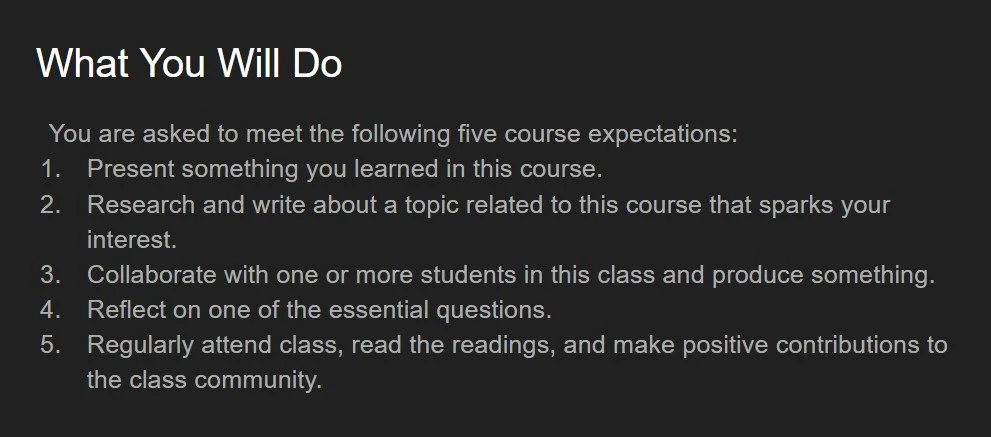
And other than the fifth expectation, I let them combine one or all of the other four. I encouraged them to play around with how they would meet the expectations. A few students completed all four as a group, submitting a research paper on the essential questions they also presented. Others combined their collaboration and presentation expectations, but did their research on their own. And a few worked on their own to meet all the expectations, except for the collaboration requirement. I really liked this approach, because I no longer had to read 23 research papers and 23 essential questions reflections. And the students really liked it because it gave them more agency in meeting the course requirements.
Overall, the trust, agency, and freedom to play around with the requirements made that class more enjoyable for me and for my students. And though my kindergarten students did get some time to play, I believe that if I had given them more trust, agency, and time for free play, they would have enjoyed learning more. And they would have experienced what my college students had, liberated learning.
Liberated learning begins with believing that children are capable, competent, and full of ideas. Rather than imposing learning from the outside in, educators can unleash children’s potential by tuning into the learning that is already happening.
I believe my kindergarten student liked learning, but her learning in school was not driven by her curiosity and did not allow her agency to shape the process. Learning in school was not liberating. But conference projects and meeting course expectations were liberating. So what would happen if we started trusting five-year-olds, giving them agency over what and how they learn, and letting them learn through play? Well, I’ve seen this in the Anji kindergartens, private preschools, and public schools that center play. I’ve seen young children spend their days engaged in liberated learning. And what I don’t see in those spaces are young children who hate going to school. When learning is liberated from standards and rules, children’s natural drive for learning is unleashed.
There are some things that will require students to sit still and learn from an adult. But before children are subjected to academic learning, they need to experience liberated learning. The more time we give them to follow their instincts, take control over what they do, and pursue their interests, the more we build the foundation needed to make academic learning easier.
Want to learn more about liberated learning? Join my free community, Free to Teach = Liberated to Learn. This month, we’re talking about liberated learning, and on Wednesday, March 18th, I’m hosting a free live discussion. Hope to see you in the community!