Why We Need to Center Freedom and Liberation in ECEC
I know some people find it strange that I’m always talking about freedom and liberation in early childhood education and care. Those two concepts are rarely linked to educating young children. When I was in graduate school, I learned about liberatory pedagogy by studying Paulo Freire and bell hooks, but those theories were typically applied to educating older teenagers and young adults. No one talked about what a liberatory pedagogy meant for young children.
Though we often talked about child-led learning and time for free play, they weren’t framed as essential to ensuring that young children experienced freedom or liberation. The first time I heard someone talk about freedom in regard to young children was when I read Troublemakers: Lessons in Freedom from Young Children at School by Carla Shalaby. This book asks us to consider creating classroom spaces that cultivate freedom as a collective responsibility, rather than spaces that suppress it. The idea of teaching young children about freedom resonated deeply with me.
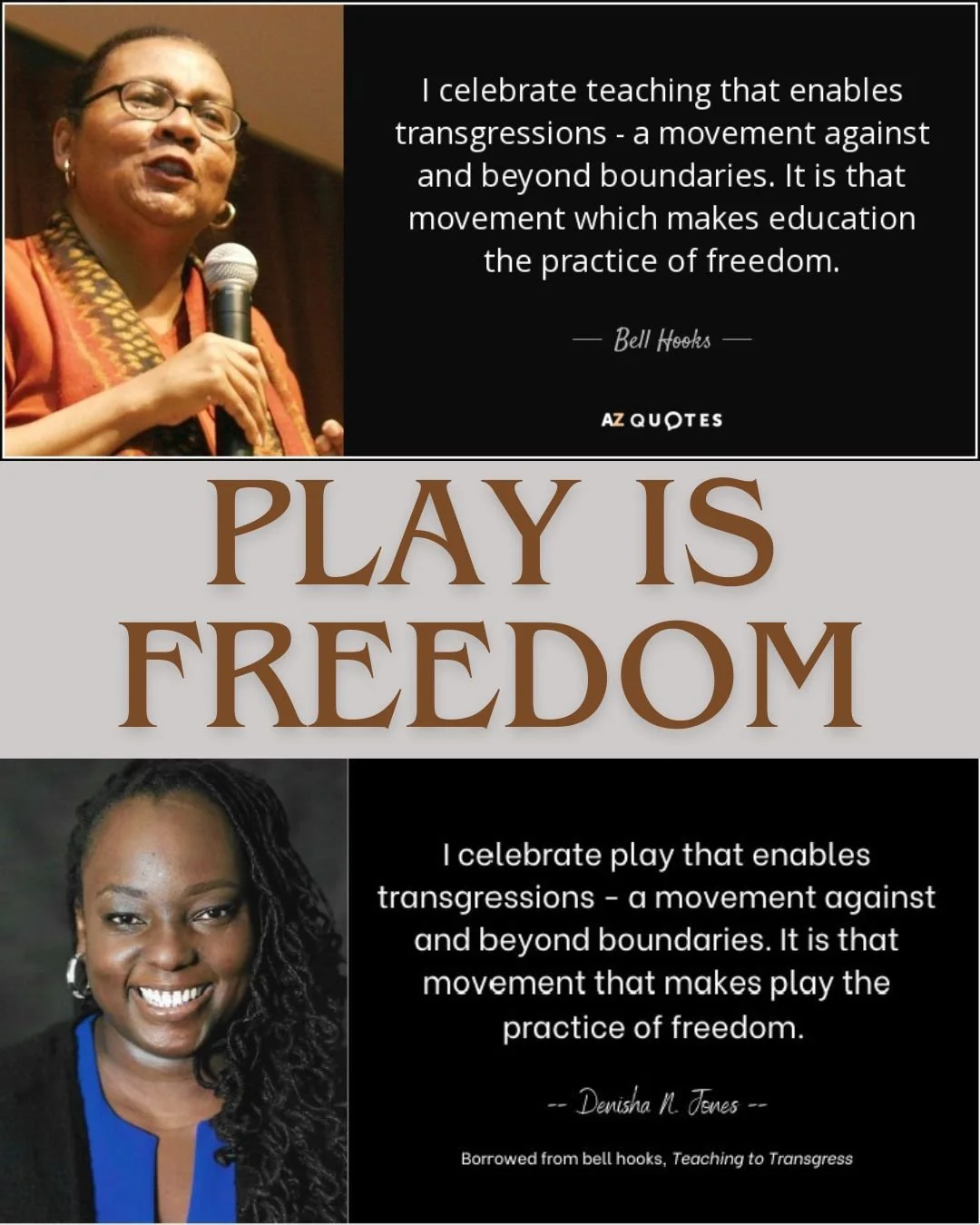
As I continued to study liberatory education as the key to resisting neoliberal education reform efforts, I thought deeply about how to apply these concepts to our work with young children. One of my favorite quotes from bell hooks is in her book Teaching to Transgress: Education as the Practice of Freedom, on page 13, she says, “I celebrate teaching that enables transgressions—a movement against and beyond boundaries. It is that movement which makes education the practice of freedom.” As I tried to connect education as freedom for young children, I realized that play, child-led free play, is a transgression or movement against the boundaries. In early childhood education, play is the practice of freedom.
These ideas really came together when I was in Anji, China, attending the first True Play Conference in May of 2019. As I observed hundreds of young children playing freely for hours, I was struck by how free they were. Ever since I was a kindergarten teacher, I have been concerned about how controlling schools are over children. One of the most significant challenges I faced as a first-year teacher was being constantly reprimanded for not having better control over my students. They were too loud in the hallways, in the lunchroom, and in our classroom, as if learning was supposed to be quiet. And when I was observed, I was told that I gave them too much freedom and not enough structure.
Though the experience made me run from the classroom and into the arms of graduate school seeking answers as to why my dream job quickly turned into a nightmare, I eventually realized that what I really didn’t like was the idea that, as a teacher, I was supposed to control 22 5 to 6-year-olds for six hours a day. Even if I could, I didn’t want to. I wanted to guide them into learning, not force them to be still. I wanted to facilitate their exploration, not drill them with lessons. I wanted to revel in their wonder, not silence their thinking. I wanted them to have the freedom to develop and learn, and I wanted to have the freedom to teach my way.
And this is what I saw in Anji. Children engaged in freedom. Free to build a slide and fly down the hill with their sled. Free to stomp in the mud. Free to make a ramp for a tire. Free to sit quietly with a friend under a table. The children were free to develop and free to learn.
And when I took a moment to observe the teachers, I realized they were free too. The teachers in Anji were free to observe and document what the children were doing. They were free to follow the children’s interests and provide support when requested. They were free to scaffold reflective discussions that engaged the children in ways I didn’t think were possible. To watch a group of children sit in a half circle and discuss their play for 30-45 minutes without a single interruption or off-task behavior felt miraculous. But when you spend 60-120 minutes engaged in freedom, you don’t need to interrupt or go off-task. The teachers were free to teach, not in an academic sense, but in ways that support authentic child development and child-led learning.
As I witnessed how true play in Anji fostered freedom among children and teachers, I also realized that play is liberation. Liberation is essential because of the boundaries that impede children’s natural development. The schoolification of kindergarten and preschool is a boundary. The use of standardized testing in the early years is a boundary. The belief that children marginalized by race and class are at a deficit is a boundary. All of these are boundaries that prevent education as the practice of freedom. And as play transgresses against these boundaries, it makes liberation possible.
Children and teachers are liberated from deficit thinking that limits our ability to see what children can do and who they are. Teachers are liberated from believing that teaching is about control. And children are liberated from didactic learning. Play is freedom, and play is liberation for children and teachers.
And given all the challenges facing people, the planet, and our future, we need to center our collective right to freedom and liberation. We can survive systems of oppression if we demand freedom and liberation for all. But we can’t wait until high school and college to teach about freedom. We must begin in the early years. We must believe that all children have a right to freedom and deserve liberation. We must believe that we, as early childhood educators and caregivers, have a right to freedom and liberation.
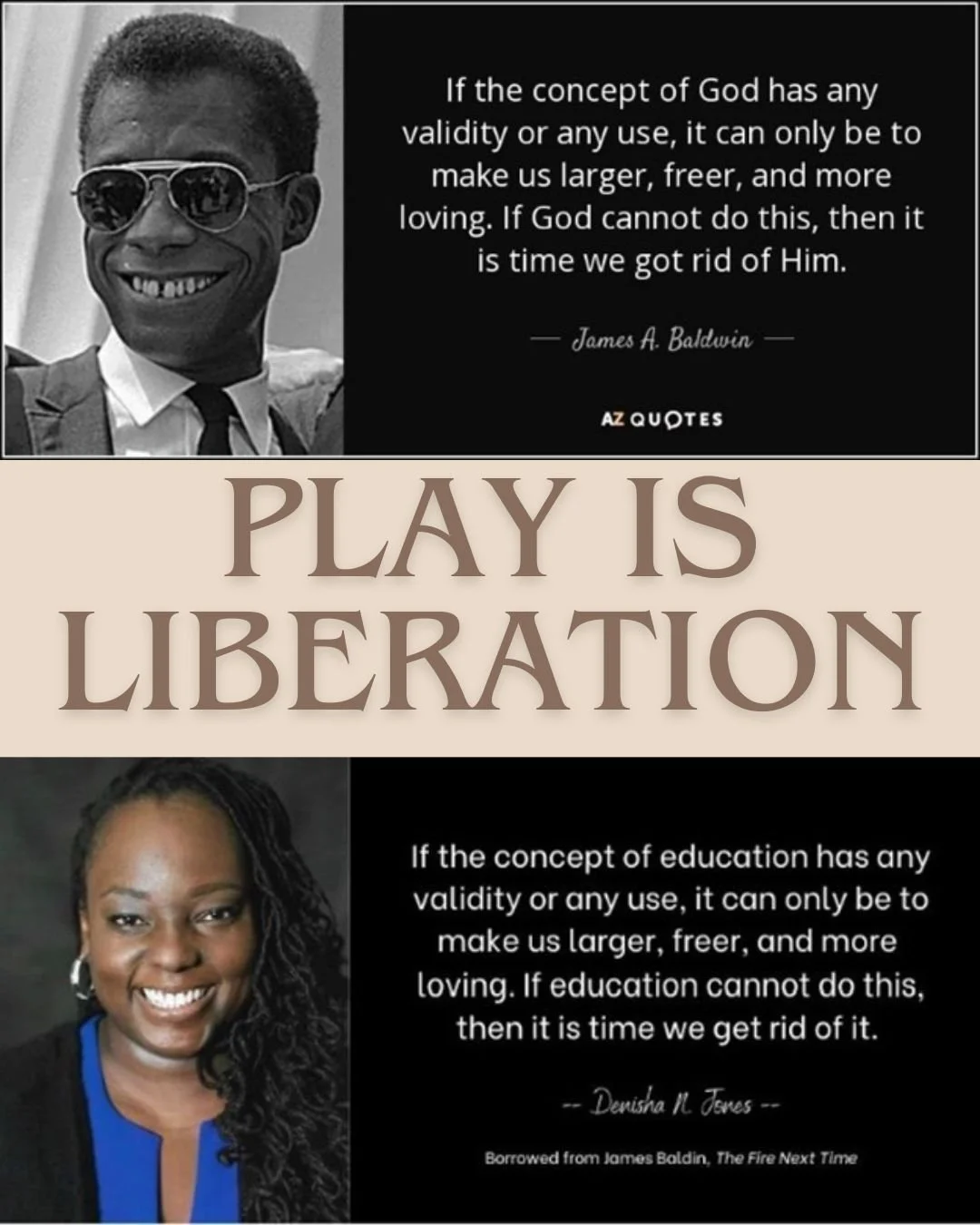
Borrowing from James Baldwin, I leave you with this revision: “If the concept of education has any validity or any use, it can only be to make us larger, freer, and more loving. If education cannot do this, then it is time we got rid of it.